Introduction
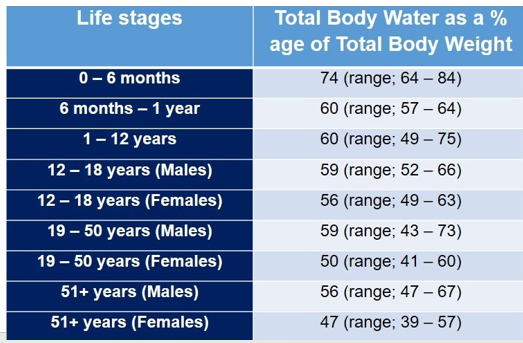
The human body is multicellular, with cells that are adjacent to one another. These cells are bathed in an aqueous fluid. This fluid is mainly water, which is the principal physiological solvent in our bodies.
internal environment “milieu intérieur”
The internal environment is a concept developed by Claude Bernard that refers to the main internal fluids that form the true living environment of the body’s cells. It is composed of plasma, lymph, and interstitial fluid. It is defined by the fluid in which the cells of the body are bathed (extracellular fluid).
It is in direct contact with the body’s cells, supplying them with the necessary substances for their functions. In the same way, metabolic waste products are discharged into the internal environment and subsequently transported to the appropriate excretory organs for elimination.
It depends on: maintaining homeostasis (balance of concentrations, osmotic pressure, pH, temperature, and electrical charge) and maintaining its dynamism, meaning the continuous renewal of its composition to preserve its homogeneity
HomeostasisHomeostasis is a term that was first coined by
physiologist Walter Cannon , Homeo,' Latinized from the Greek word 'homio,'
means 'similar to,' and
the word 'stasis,' meaning 'standing
still’ ,
Homeostasis is the ability of living organisms to keep their internal
conditions stable (steady internal states)
through specific biological mechanisms. For example sodium, Its normal concentration
in the human blood varies about 7% within a range of 138–146 mmol/
The different fluid compartments
The human body contains two major fluid compartments:
The extracellular fluid compartment (ECF), which represents about one-third of total body water.
The intracellular fluid compartment (ICF), which represents about two-thirds of total body water; It includes all the water contained within the cells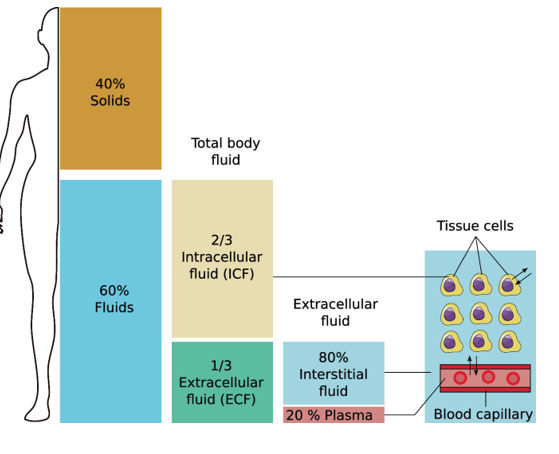
The extracellular fluid compartment (ECF)
The Blood :
Blood is a vital biological fluid that circulates continuously through the blood vessels and the heart, driven especially by the heart’s pumping action. It consists of a liquid component, the plasma, and billions of cells mainly red blood cells, which give blood its characteristic color.
Blood transports oxygen (O₂) and nutrients essential for the survival and functioning of all body tissues and carries waste products such as carbon dioxide (CO₂) and nitrogenous wastes to the organs responsible for their elimination (kidneys, lungs, liver, and intestines).
In addition, blood delivers immune cells and molecules to tissues and distributes hormones throughout the body. In adults, blood cells are produced in the bone marrow through a process known as hematopoiesisLymph
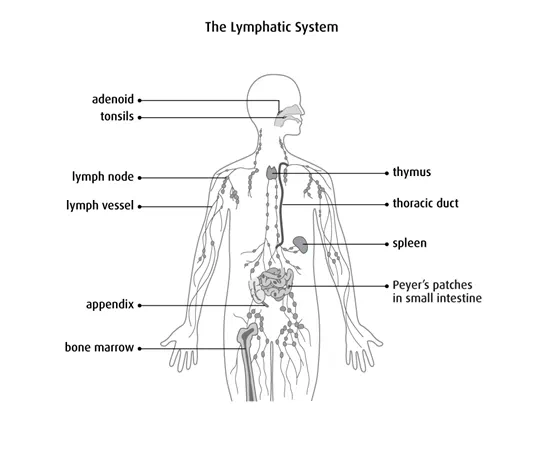
Lymph is a clear, yellowish fluid that circulates through the lymphatic vessels and lymph nodes. It contains white blood cells especially lymphocytes which play a major role in the immune response by producing antibodies to fight bacteria, viruses, and fungi. Lymph also transports antibodies that neutralize or destroy foreign substances (antigens) that enter the body, as well as nutrients throughout the organism.
Interstitial fluid
Interstitial fluid, also called the interstitium, has an ionic composition similar to that of blood plasma. It fills the space between blood capillaries and cells, allowing the exchange of nutrients, gases, and waste products between them. Excess interstitial fluid is collected by lymphatic capillaries, where it becomes lymph, and is transported through the lymphatic system to the neck. There, it is returned to the bloodstream via the thoracic duct and the left subclavian vein.
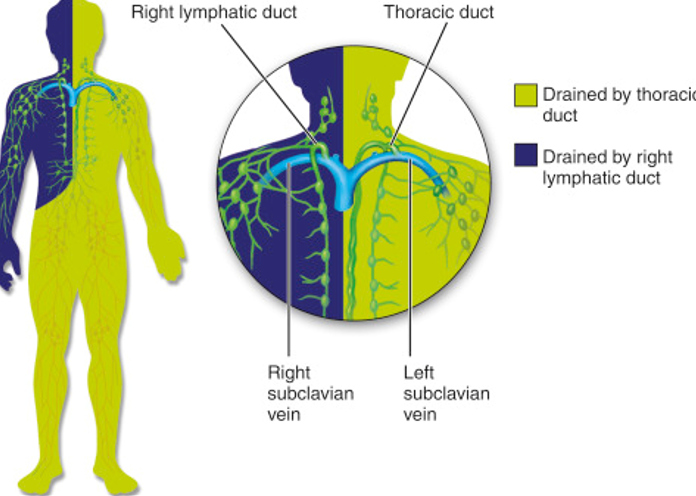
Measuring the volume of liquid compartments
The volume of a fluid compartment is measured indirectly by diluting a known quantity of tracer(= indicator = marker). Once the tracer reaches equilibrium meaning it has been distributed uniformly throughout the compartment being studied the volume can be calculated using the dilution formula:
The tracer must have certain properties:
• Homogeneous distribution within the compartment being studied
• It must not diffuse into other compartments
• It must not be metabolized or synthesized
• It must not be toxic
• Its measurement must be rapid.

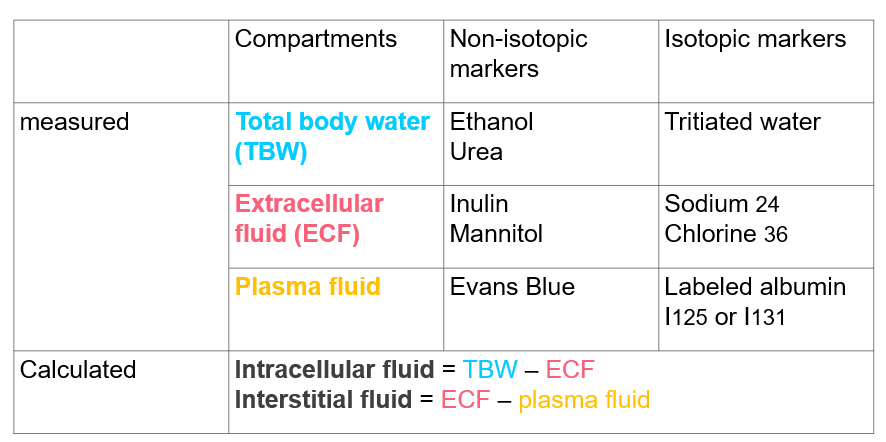
Blood volume measurement
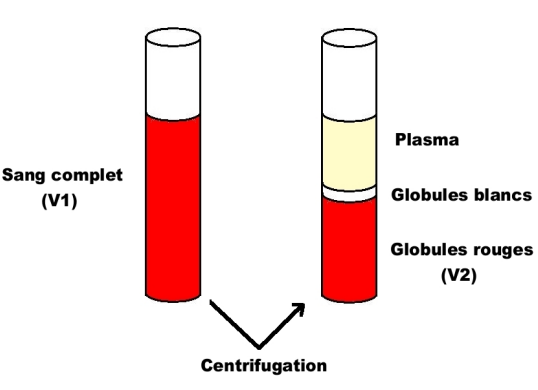
Blood volume is measured using Evans blue, which does not pass through the capillary walls (stays only in the plasma and does not enter cells or other compartments); it binds strongly to albumin.
Hematocrit calculation: Hematocrit = V2/V1
V1: Volume occupied by red blood cells after centrifugation
V2: Whole blood
Hematocrit is the percentage (%) of red blood cells, Total blood volume can then be calculated using the following formula:

Mr.
L. receives an injection of 100 mg of Evans Blue. A blood sample is taken 10
minutes later, and the dye concentration in the plasma is found to be 0.037 mg/mL.
Another blood sample is drawn, with a total volume of 100 mL.
After centrifugation, the volume of packed red blood cells is 45 mL.
Calculate Mr. L.’s plasma volume and total blood volume.
PV= 100/ 0,037= 2703 ml Plasma Volume = 2.7 L
Hematocrit = 45/100= 0,45
TBV= 2,7/1-0,45 total blood volume= 4,9 L
These values are within normal range for an adult male:
Plasma volume: 2.5–3.0 L
Blood volume: 4.5–5.5 L
So Mr. L’s results are physiologically normal.
Composition of fluid compartments
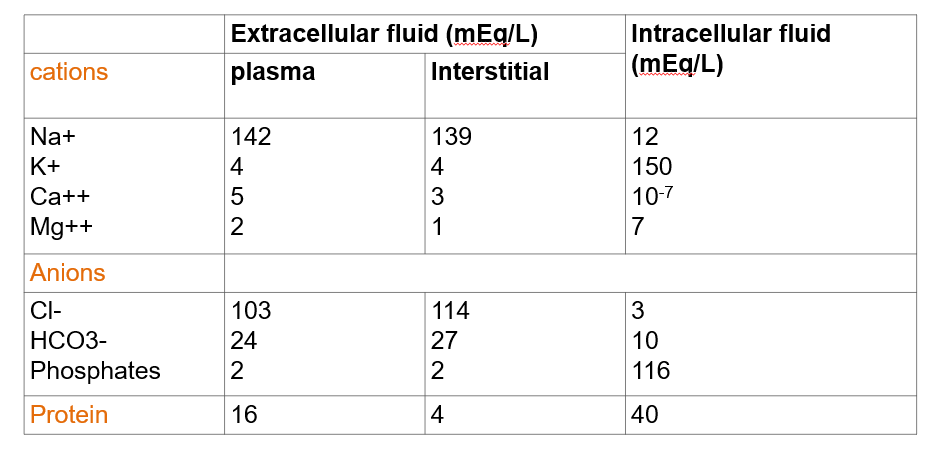
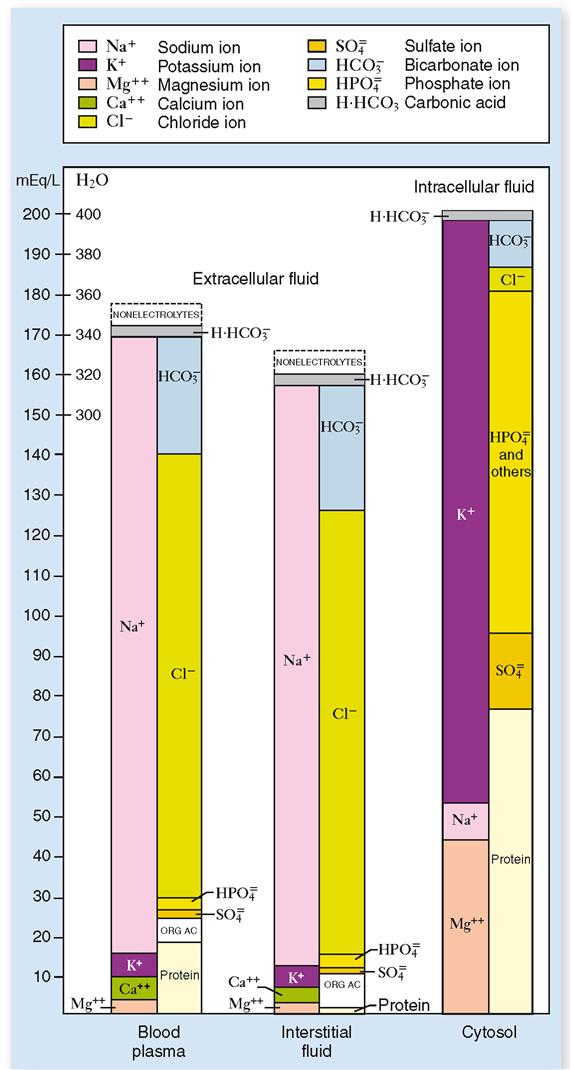
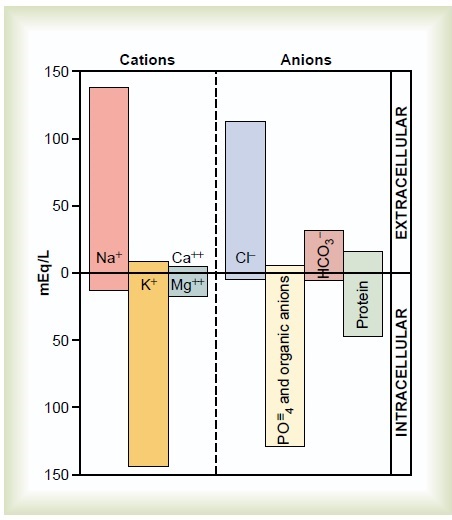
The comparative ionic composition of ECFand ICF
Intracellular and extracellular fluids do not have the same composition. The intracellular fluid is rich in potassium (K⁺) and phosphorus (mainly as phosphate ions, PO₄³⁻), which are crucial for energy exchange. It is poor in sodium (Na⁺), chloride (Cl-) and calcium (Ca²⁺). Because calcium tends to precipitate in the presence of phosphate, only a small amount of calcium is found in the cytosol; most of it is stored in organelles such as the mitochondria and endoplasmic reticulum. The unequal distribution of Na⁺ and K⁺ across the plasma membrane is maintained by the Na⁺/K⁺-ATPase pump.
Comparative ionic composition of plasma and Interstitialfluid
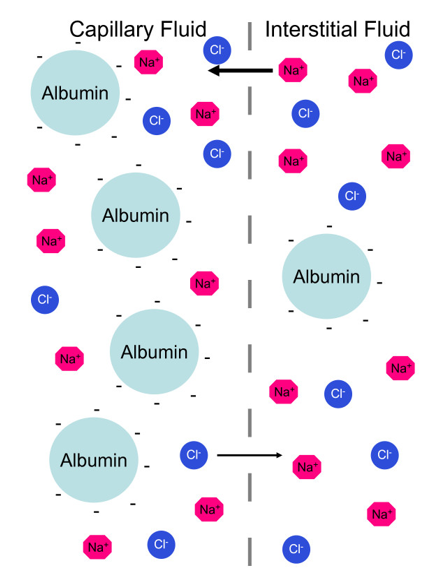
The ionic composition of plasma and interstitial fluid is almost identical, except that plasma contains approximately 70 g/L of proteins compared to about 7 g/L (almost none) in interstitial fluid. Plasma also contains slightly more Na⁺ and slightly less Cl⁻ and HCO₃⁻. This distribution is due to the balance of Gibbs-Donnan
When two compartments are separated by a membrane semi permeable that allows small ions (Na⁺, K⁺, Cl⁻) to pass but not large charged molecules like proteins⁻, an unequal distribution of ions occurs. On the plasma side, negatively charged proteins that cannot cross the membrane attract positive ions and repel negative ones. This leads to a small difference in ion concentrations between plasma and interstitial fluid, a phenomenon known as the Gibbs–Donnan effect.