
Beyond the aminoacyl-Trna synthetases, the Trna, ribosomes, and Mrna this synthesis requires several proteins called factors of initiation, elongation and termination, while the energy is provided by the molecule of GTP. The different structures in the Mrna prokaryotes and eukaryotes involve different pathways for these events.
Translation in eukaryotes
Commechezlesprocaryotesondistinguetroisétapesdanslasynthèseprotéiquechezles eukaryotes (initiation, elongation and termination).
A. Initiation
The initiation is similar to that in prokaryotes in several aspects. Both use an initiation codon and a Trna initiator, and the two relate to factors of initiation to form a complex with the small ribosomal subunit that binds to the Mrna before the addition of the large subunit. However, eukaryotes use a completely different method to recognize the Mrna and the initiation codon.
In eukaryotes, the small subunit is already associated with a Trna initiator. In contrast to prokaryotes, the binding of the Trna initiator (loaded by a methionine non-modified) to the subunit 40S always precedes the association with the Mrna. The recognition of the Mrna involves a number of factors auxiliary. The ribosome recruited at the level of the cuff is 5' of the Mrna scans the Mrna in the direction 5' □ 3' until it reaches the sequence of Kozak5'CCAUGG3', this sequence allows us to understand the initiation codon (AUG). Finally, the large subunit of the ribosome is recruited After the base-pairing of the Trna initiator with the initiation codon. At the end of a cycle of translation, the ribosome eukaryotic dissociates into its sub-units.
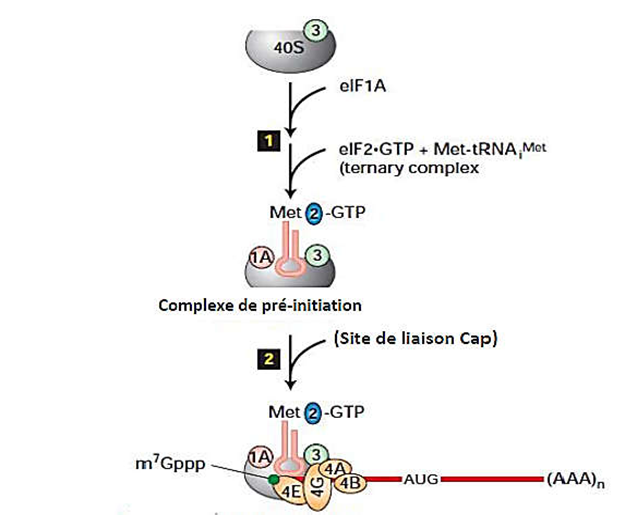
Figure 17 : Formation of the initiation complex in eukaryotes