
The work of Kornberg revealed that the precursors of DNA were nucleotide-Rich in energy (dNTP, dCTP,dTTP,dGTP).Each nucleotide is composed of acid phosphoric (3), and nitrogen base (A, T, C, G) and a pentose (2'-deoxy-β-D-Ribose). The connection formed between two phosphates gives an anhydride with a binding, very rich in energy, and is the liaison between the group of acid phosphate and the hydroxyl group of the sugar gives an ester bond. The link formed Between the sugar and the base is a binding saccharide-type β-N- glycosidic linkage.
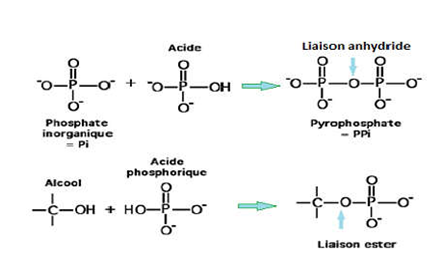
Figure 4: Forms of phosphate, and the bonds formed.
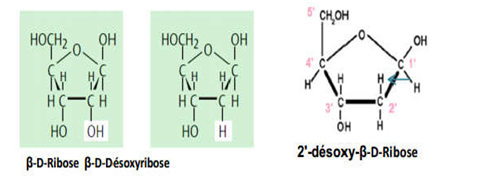
Figure 5 : A- The pentoses, which are included in the composition of nucleic acids (DNA, RNA). B-Numbering of a sugar, the prime (') is added in the numbering for the distinguish to that database
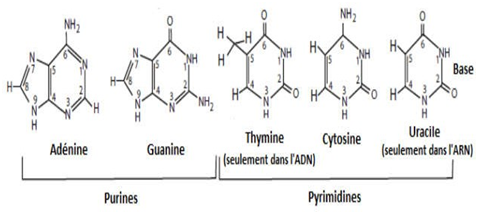
Figure 6: The five nitrogenous bases of DNA and RNA (Purines [A G], Pyrimidines [C, T, and U].
Moreover, there are also bases purine-modified:
- In the DNA, for example, the N6- methyladenine
- In lesARN(in particular, RNAt), we find, for example, theN -7- methylguanine andhypoxanthine.
And bases pyrimidine modified :
- In DNA, the most common is the N5- méthylcétosine.
- In RNA, found, among other bases not very common, the
Pseudouracile and the dihydrouracile.
Acids désoxyribonucléiques are very large molecules composed of two chains polynucléotidiques wrapped one around the other to form a double helix regular (form B has a diameter of 2.47 nm).
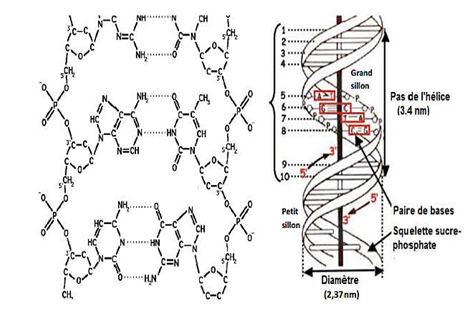
Figure7: detailed Structure of the double helix of DNA (form B). A helical turn covers approximately 10.5pb (34Å). The backbone of each strand is composed of sugar and phosphate. The nitrogenous bases are projected towards the interior of the molecule, but remain accessible to the solvent by two sulci (small and large groove)
Lastabilisationdeladoublehélices'effectuepardesliaisonschimiquesfaibleetnon covalent both internal and external:
1- Hydrogen bonds between the bases.
2- Hydrophobic Interactions and electronic between bases
3- Interactions of the groups in sugar and phosphate with aqueous (hydrophilic interactions).
This stability does not result in a rigidity of the DNA molecule and can adopt different conformations depending on the region. Several conformations corresponding to the winding direction different or not different have been found, with the main ones being :
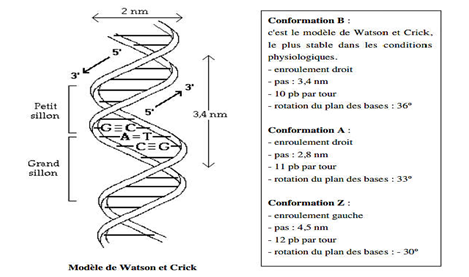
Figure 8: detailed Structure of the double helix of DNA (form B). A helical turn covers approximately 10.5 pb (34Å). The backbone of each strand is composed of sugar and phosphate. The nitrogenous bases are projected towards the interior of the molecule, but remain accessible to the solvent by two sulci (small and large groove)