
Chapter 3 : Membrane
Pumps(Transport of organic substances)
III.5.1.2.F-type pumps (F₀F₁
ATPases)
F-type pumps (F₀F₁ ATPases): these pumps are H⁺-ATPases.
F-type ATPases are key active transporters involved in energy-conserving processes in mitochondria, bacteria, and chloroplasts. They couple ATP hydrolysis to the energetically unfavorable transmembrane transport of protons. The term “F-type” originates from their initial identification as energy-coupling factors.
F₀F₁ ATP synthases are composed of multiple subunits:
Ø a transmembrane F₀ part, which functions as a proton channel,
Ø an extramembranous F₁ part, which can carry out either ATP synthesis or ATP hydrolysis.
The F₀F₁ ATP synthase is located in the inner membrane of mitochondria. The energy required for ATP synthesis is supplied by the proton gradient generated by the redox pumps of the respiratory chain.
The central role of the F₀F₁ ATP synthase is to provide the ATP necessary for the functioning of all other ionic pumps in the cell.
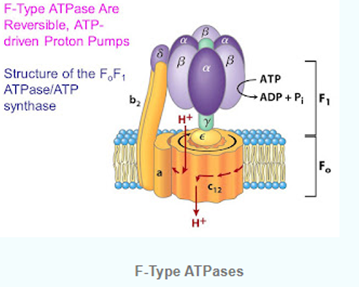
Figure 41 : F-type pumps (F₀F₁ ATPases)
III.5.1.1 V-type pumps (vacuolar)
V-ATPases are found throughout all kingdoms of life and share a common origin with the F-ATPases and the archaebacterial A-ATPases. Like their ancestors, V-ATPases are nanometre-scale molecular machines that perform rotational catalysis (see Figure 1): the ATP-hydrolysis motor V1 and the proton turbine V0 are functionally connected by a central shaft. ATP-hydrolysis at the catalytic nucleotide binding sites found at the interfaces of the hexameric arrangement of V1 subunits A and B induces rotation of the central shaft (subunits d, D, F), which is conveyed to the proteolipid-ring (subunits c, c′, c″). Rotation of the c-ring against subunit a, that provides the second part of the proton channel, then drives protons across the membrane. Co-rotation of the two domains is prevented by four connections between V1 and V0 that is provided by subunits a, E, G, C, and H [1–4].
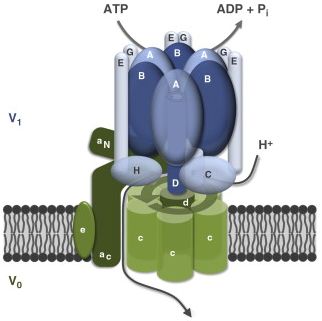
Figure 42: V-type pumps
III.5.2. ABC pumps (ATP-binding cassette)
ABC pumps (ATP-binding cassette) are transmembrane proteins that use the energy from ATP hydrolysis to transport molecules across cellular membranes. They are present in all organisms and can import or export a wide variety of substrates such as peptides, sugars, metabolites, ions, and drugs. Their role is crucial in functions such as nutrient absorption, toxin elimination, and drug resistance.
Why
are we interested in this family of transporters?
The chemoresistance of certain tumors is due to the overexpression of a
transporter from the ABC family (MDR1),
which expels xenobiotics (drugs) out of the cells.
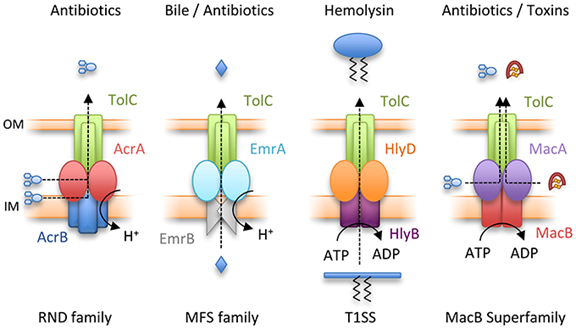
Figure43 : ATP-binding cassette pump
III.5.3.Light-driven pumps
Owing to its simplicity, its small size, and the availability of a high-resolution structure .more is known about light-driven transport of protons by bacteriorhodopsin than about any other pump. This pump allows the halophilic (salt-loving) Archaea Halobacterium halobium to convert light energy into a proton gradient across its plasma membrane. The 26-kD pump packs into two-dimensional crystalline arrays in the plasma membrane. The polypeptide is folded into seven α-helices that cross the lipid bilayer. The light-absorbing .
chromophore retinal (vitamin A aldehyde) is bound covalently to the side chain of lysine 216 (Lys216) via a Schiff base. This chromophore makes the protein and the membrane purple.
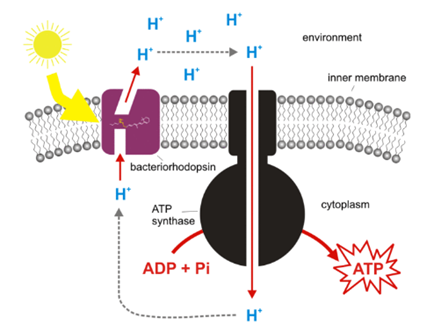
Figure44 : proton pathway across the membrane through bacteriorhodopsin.
III.6.Glucose transporters
Glucose transporters are specialized proteins that facilitate the movement of glucose across cell membranes, which are otherwise impermeable to most substances due to their polar nature. These transporters play a crucial role in delivering glucose, a primary energy source for many mammalian cells, enabling various bodily functions essential for life. There are two main classes of glucose transporters: sodium-glucose cotransporters (SGLTs) and facilitative glucose transporters (GLUTs) .
III.6.1.GLUT transporters
Glucose enters the cell through specialized proteins known as glucose transporters, or GLUT transporters. These transporters facilitate the movement of glucose across the cell membrane, which is essential because glucose is a water-soluble molecule and cannot cross the membrane through simple diffusion. GLUT transporters are bidirectional, meaning they allow glucose to flow both into and out of the cell, depending on the concentration gradient.
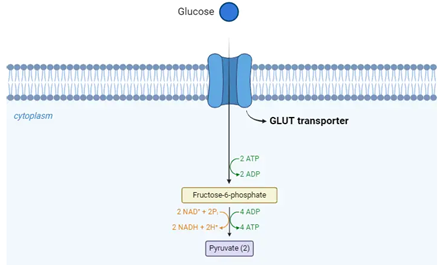
Figure 45 : GLUT transporter
III.6.2.SGLT Transporter
SGLT (Sodium-Glucose Linked Transporter) proteins are crucial membrane transporters that move glucose into cells, powered by the sodium gradient, primarily in the intestines (SGLT1) for absorption and kidneys (SGLT2, SGLT1) for reabsorption, preventing glucose loss in urine. SGLT1 absorbs glucose from food, while SGLT2 reabsorbs most filtered glucose in the kidneys. Inhibiting SGLT2 is a key diabetes treatment, reducing blood sugar by increasing glucose in urine, and also offers heart and kidney benefits.
Mechanism of SGLT (Na⁺/Glucose Symporter)
1.
Creation of the Na⁺ gradient :The Na⁺/K⁺-ATPase
on the basolateral membrane pumps Na⁺
out of the cell using ATP.
This creates an electrochemical Na⁺ gradient (high outside, low
inside).
2.
Sodium (Na⁺) binding :On the extracellular
side (intestinal lumen or renal tubule), Na⁺ binds first to the SGLT
transporter.
This binding increases the transporter’s
affinity for glucose.
3. Glucose binding :Glucose then binds to the transporter.
4. Conformational change :The simultaneous binding of Na⁺ and glucose induces a conformational change in the transporter.
5. Translocation into the cell:The transporter opens toward the cytoplasm and releases Na⁺ and glucose into the cell.
6. Sodium extrusion :Na⁺ is subsequently pumped out of the cell by the Na⁺/K⁺-ATPase, maintaining the gradient.
7. Glucose exit :Glucose exits the cell via facilitated diffusion through GLUT transporters (e.g., GLUT2)
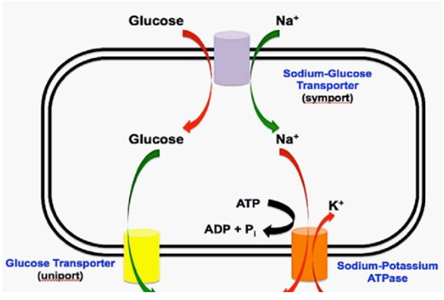
Figure46 : SGLT Transporter