
1) Definition
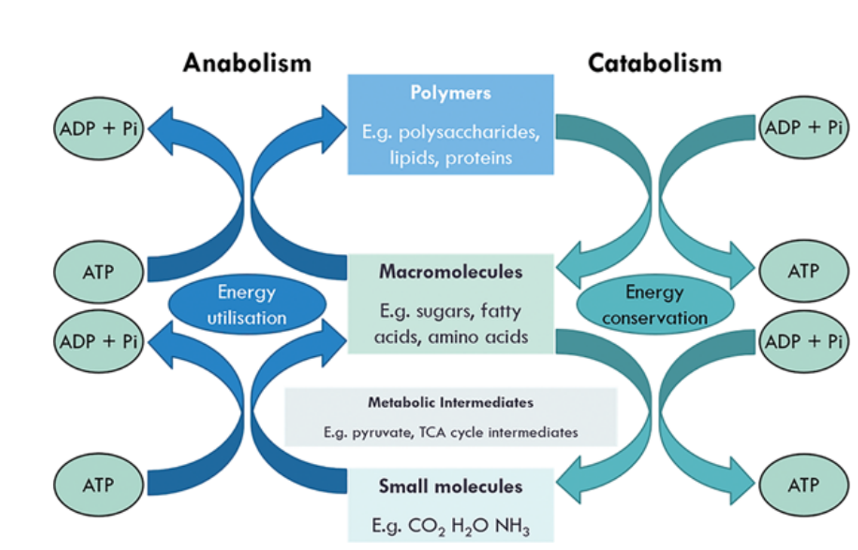
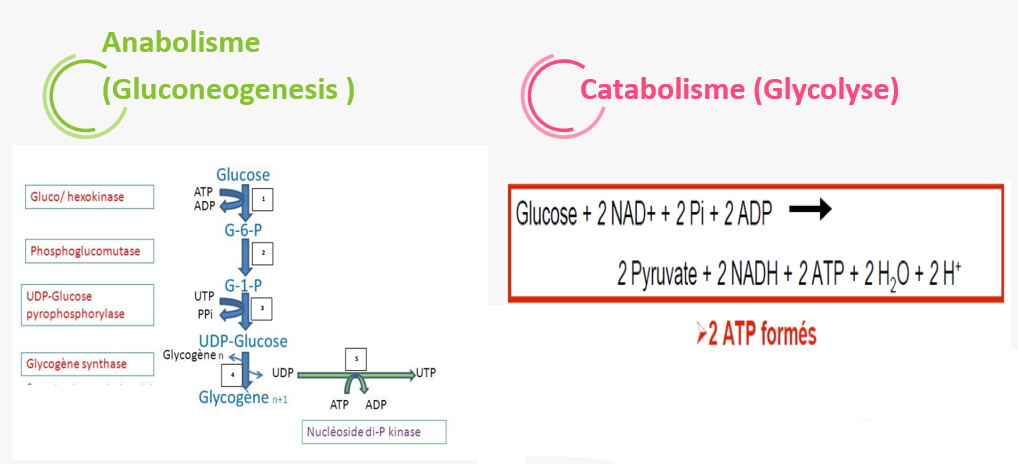
Autotrophs produce their own food by either photosynthesis or chemosynthesis. Autotrophs are at the primary level of food chains. Thus, heterotrophs are at the secondary or tertiary levels of the food chains. The main difference between autotrophs and heterotrophs is that autotrophs are capable of forming nutritional organic substances from simple inorganic substances such as carbon dioxide whereas heterotrophs are unable to produce organic compounds from inorganic sources.
3) What is Thermodynamics?
Thermo = heat, dynamics = power
Thermodynamics is a branch of science that deals with the transformation of different forms of energy, and how the energy is utilized
Types of Energy: Thermal, Mechanical, Chemical, Electrical, Light
Laws of Thermodynamics
The first law of thermodynamics : Principle of energy conservation
states that energy can neither be created nor destroyed but can be transformed from one form to another
-Example: the hydrolysis of ATP (chemical energy) is necessary for muscular contraction (mechanical energy) transformation from one form of energy to another.
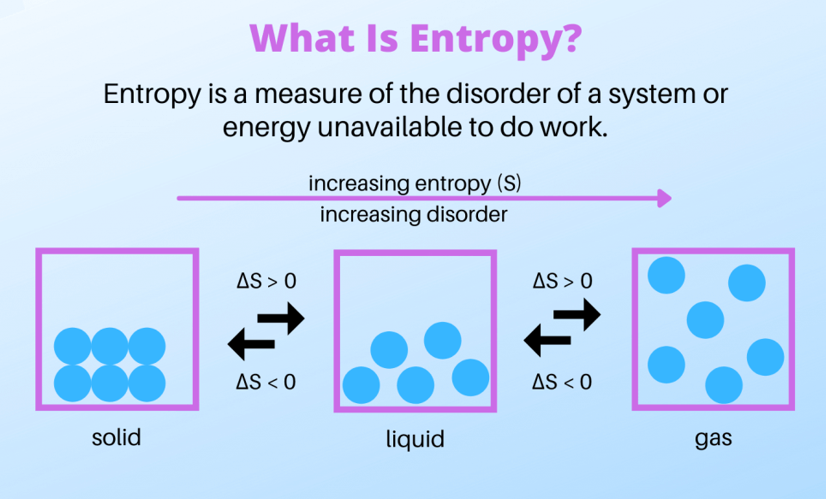
The second law of thermodynamics :Increase in entropy
During energy production, the systems involved evolve from an ordered state to a less ordered state. The resulting disorder is called entropy (S): energy degrades as it transforms.
For example, when cells perform their functions, they convert some of the energy into heat.
Unit of measurement of energy:
The unit of measurement is the kilocalorie (Kcal). 1 Kcal represents the amount of energy needed to raise the temperature of one liter of water by 1°C.
1Kilocalorie = 1Kcal = 1Cal = 1000 cal = 4.185 KJ
4) Sources of
Energy
Carbohydrates, fats, and proteins are the major energy sources for the resynthesis of adenosine triphosphate (ATP), the main energy-carrying molecule used by cells. Alcohol represents an additional source of energy but is less relevant in magnitude. These nutrients are acquired from the environment by the intake of different foods.
The macronutrients absorbed are directly oxidized for ATP resynthesis or stored within the body. Carbohydrates are stored as glycogen, mostly in the liver and skeletal muscle. Fats are stored as triglycerides mostly in adipose tissue. Proteins are mostly used to build lean tissues, including skeletal muscle, and normally play a lesser role as an energy fuel.
5) Components of total daily energy
expenditure (TDEE)
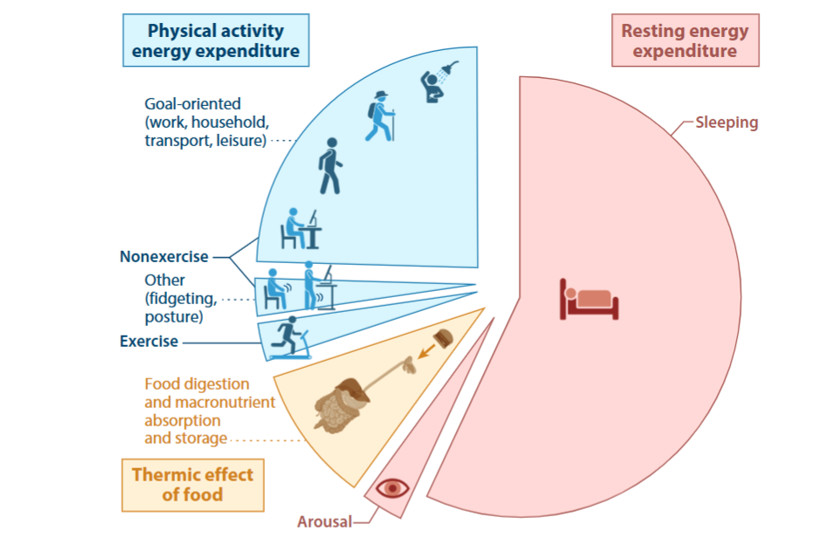
TDEE is broadly partitioned into Resting Energy Expenditure (REE), Physical Activity Energy Expenditure (PAEE), and Thermic Effect of Food (TEF). These components represent approximately 60%, 30%, and 10% of TDEE, respectively, in healthy, free-living, nonathlete individuals under thermoneutral conditions
REE= Basal or Resting Metabolic Rate
Basal or resting metabolic rate (BMR or RMR) is the amount of energy per minute the body uses to maintain a quiet resting state. This is approximately 1 Cal per minute. Over the course of the day (and night), a person will expend a substantial amount of calories just to maintain the body (1440 minutes in a day x 1 Cal/min = 1440 Cal per day). Approximately 60% to 75% of the energy used every day is needed to maintain the essential body functions that sustain life. These functions include nervous system activity, breathing, heart function, maintenance of body temperature (thermoregulation), and hormone activity.
Age: Metabolism slows with age (2% to 3% per decade after 30 years of age), primarily due to a loss in muscle tissue, but also due to hormonal and neurological changes.
Gender: Generally, men have a faster metabolism than women because they tend to be larger and have more muscle tissue.
Body size: Larger adult bodies have more metabolically active tissue, which leads to a higher BMR/RMR.
Body composition: Muscle tissue uses more calories than fat, even at rest.
Genetic predisposition: Metabolic rate may be partly determined by genes
Growth: Infants and children have a higher BMR/RMR related to the energy needs of growth and maintenance of body temperature.
Hormonal and nervous controls: Hormonal imbalances can influence how quickly or how slowly the body burns calories.
Environmental temperature: If temperature is very low or very high, the body must work harder to maintain a normal temperature; this increases the BMR/RMR
Infection or illness: BMR/RMR increases if the body must build new tissue or create an immune response to fight infection.
Crash dieting, starving, or fasting: Eating too few calories encourages the body to conserve energy. There can also be a loss of lean muscle tissue, which contributes to reducing BMR/RMR
Physical activity: Regular exercise increases muscle mass, which increases energy consumption, even at rest.
Stimulants: Use of stimulants (e.g., caffeine) increases energy expenditure at rest. However, this is not a healthy way to lose weight
Physical Activity Energy Expenditure
Physical activity can be parsed into exercise and nonexercise activities. Exercise represents a physical activity that is planned, structured,
and repetitive, aimed at maintaining or improving physical fitness. Nonexercise physical activity includes all
remaining activities, such as activities in the leisure, work, household, and
transportation also unconsciously activities include fidgeting and muscle tone
for maintaining body posture . The proportion of PAEE explained by exercise and
nonexercise activities varies according to the individual’s lifestyle and
conditions
TEF or DIT represents the energy used for the ingestion and digestion of food, along with the absorption, transport, and storage of nutrients . The contribution of each process to the TEF depends mostly on the characteristics of the food, including the type, macronutrient composition, and energy content. Storage of glucose as glycogen requires an energy expenditure equivalent to 5% of the energy contained in glucose. Storage lipids in adipose tissue requires only 2 to 3% of the energy provided by lipids. Protein synthesis induces a sharp increase in postprandial energy expenditure (25% to 30% of the energy from ingested proteins).
Special cases: Growth, gestation, and lactation require a daily caloric supplement, about 400 calories per 24 hours, sometimes much higher.