
Chapter 04 : Donnan effect
IV.7. Donnan Equilibrium
Consider two compartments separated by a dialysis membrane:
· Compartment 1 contains only an ionic solution.
· Compartment 2 contains pure water.
The ions diffuse and distribute themselves on both sides of the membrane. The presence of ions in each compartment at different concentrations creates a membrane potential difference. These are electrochemical potentials.
This difference in electrochemical potentials is given by the Nernst equation.
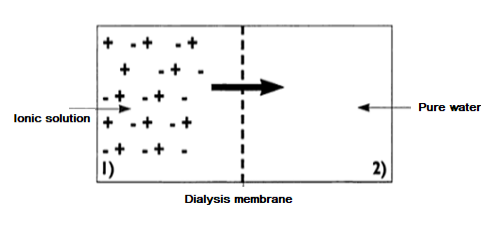
Figure :Dutrochet’s Application
Formula:
Where:
· z = algebraic value of the ionic charge
o Example: z(Na+)=+1z(\text{Na}^+) = +1z(Na+)=+1, z(SO42−)=−2z(\text{SO}_4^{2-}) = -2z(SO42−)=−2
· F = Faraday constant = 96,500 C·mol⁻¹
· R = gas constant
· T = absolute temperature (K)
· C₁, C₂ = ion concentrations on sides 1 and 2 of the membrane.
The ions have distributed themselves evenly on both sides of the membrane; therefore:
C1=C2
As a result:

· Thus:
· V1=V2
· There is equality of electrochemical potentials on both sides of the membrane
Donnan was the first to describe this phenomenon in 1911.
VI.7.1.Vonnan Membrane Equilibrium
· The Donnan membrane equilibrium condition states that for all the species which can cross a membrane are in equilibrium
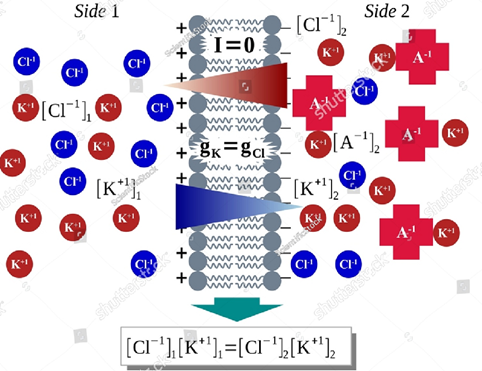


· even when we add a protein Pr- to one side that cannot pass the membrane, the above expression will stay the same! But we will create an ICE table (will see in examples)
· The different concentrations of ions across the membrane causes an electric potential across the membrane and can be found using the following equation

i=ion
[i]=ion concentration at eqm
zi=charge of that ion
· Note that the right and left are arbitrary. No matter which way you set a problem up the voltage will be the same. The only difference will be the sign of the voltage. Questions typically ask for the absolute value of the voltage.
· The difference in ion concentrations can produce an osmotic pressure across the membrane and we can express that change in pressure as follows.

where 𝛥𝑐 is the difference in total concentration across a membrane
In figure 2.6.3 Δc = {[Ca2+]L + [Br- ]L + [Pr- ]L} – {[Ca2+]R + [Br- ]R}