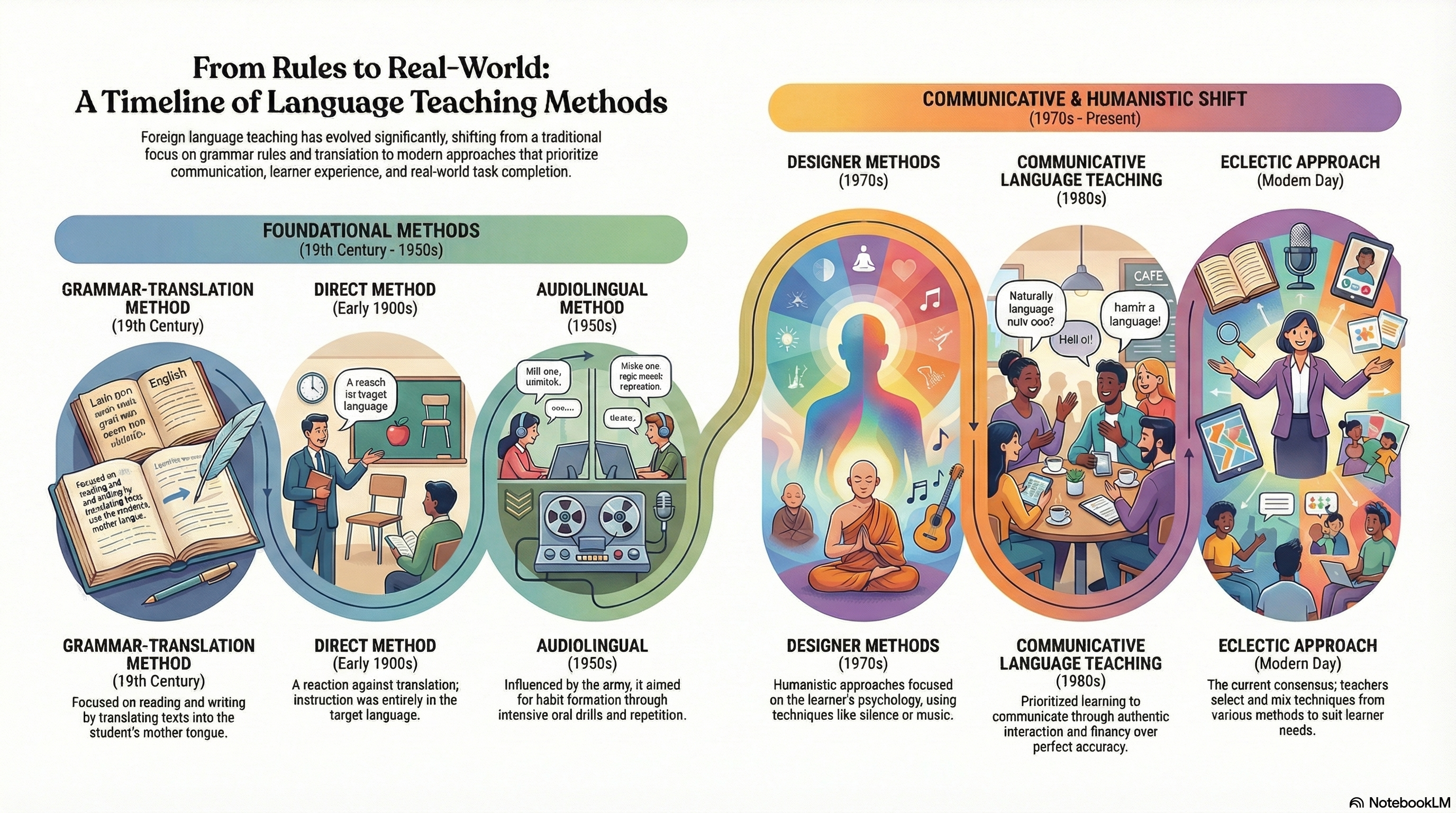
The Evolution of Foreign Language Teaching Methods (Part 2)
4. Designer Methods (Humanistic Approaches)
Developed primarily in the US during the 1970s and 1980s, these methods were influenced by principles of psychology and psychotherapy. Examples include the Silent Way, Total Physical Response (TPR), and Suggestopedia.
The Silent Way
This approach, conceived by Caleb Gattegno, is characterized by a problem-solving approach that seeks to develop student independence and autonomy.
- Learning is facilitated if the learner discovers or creates knowledge rather than simply remembering and repeating it.
- The teacher is generally silent (Teacher's Silence), only giving help when absolutely necessary, encouraging self-correction gestures and peer correction.
- Teaching utilizes mediating physical objects, such as the Sound-Colour Chart (where each color symbolizes one sound) to help students point out and build words with correct pronunciation.
To understand this method, watch this teacher using it
Suggestopedia
Developed by Georgi Lozanov, Suggestopedia aims to overcome learners' psychological barriers to learning.
- Lozanov suggested that the human brain can process great quantities of material if given the right conditions, including a state of relaxation.
- The environment is designed to be very comfortable, featuring dim lighting and soft cushioned seating.
- Baroque music is played softly in the background to increase mental relaxation and the potential to retain new material.
- Psychological barriers are "desuggested," and students are encouraged to be child-like and assume new roles/names.
- Errors are tolerated, with the emphasis placed on content over structure.
To understand this method, watch this teacher using it
Total Physical Response (TPR)
This method, developed by Dr. James J. Asher, is based on the idea that second language acquisition parallels first language development.
- TPR relies on listening linked to physical activities designed to reinforce comprehension.
- Students respond to commands that require physical movement.
- Appropriate activities can produce stress-free learning, and learners are encouraged to speak only when they feel ready.
- The underlying theory of language is grammar-based, often focusing on the verb in the imperative form.
To understand this method, watch this teacher using it
5. Modern Approaches
Communicative Language Teaching (CLT)
Dating from the 1980s, CLT emphasizes learning to communicate through interaction in the target language.
- The goal of classroom activities should be authentic and meaningful communication.
- Fluency is considered an important dimension of communication, and learning involves creative construction (trial and error).
- CLT incorporates authentic texts and attempts to link classroom learning with language activation outside the classroom.
To understand this method, watch this teacher using it
Task-Based Language Learning (TBLL)
TBLL is a method focused on using authentic language for students to complete meaningful tasks (e.g., conducting an interview or visiting the doctor).
- The role of the teacher changes from an instructor/prosecutor of errors to a supporter and inventor of tasks.
- The learning process is often divided into a task cycle of pre-task, doing of the task, and post-task phases.
- Assessment is primarily based on task outcome (appropriate completion) rather than the accuracy of language forms, making it useful for developing fluency and student confidence.
To understand this method, watch this teacher using it
6. The Contemporary Reality: Eclectic Approach
While various single-theory methods have risen and fallen, critics argue that many are not based on clear theory, are open to wide interpretation, and represent different configurations of the same basic teaching options. Additionally, methods developed in specific contexts cannot be exported wholesale.
In response, many educators now favor a Principled Eclecticism.
Core Principles of Eclecticism:
- It is a coherent, pluralistic approach that involves using a variety of ideas and procedures from different existing methods.
- Reliance upon a single theory has been criticized because using a limited number of techniques can become mechanical.
- The teacher decides which approach or methodology to use based on the aims of the lesson and the learners' needs.
Advantages of Eclecticism:
- Safety: Using a variety of procedures increases the chances of learning taking place.
- Interest: Teachers need different techniques to hold learners' attention.
- Flexibility: Awareness of a range of available techniques helps teachers manage unexpected situations and exploit materials better. Informed teaching is inherently eclectic.
Conclusion
This lecture summarizes the evolution of foreign language teaching, detailing the foundational theories, classroom practices, and philosophical shifts that have shaped the field from the 19th century to modern communicative approaches.