
This video is a summary of Lectures 3 and 4
1. Comprehensible input: Krashen
• It is one of the models that adopts the innatist perspective.
• It was quite influential in the 1970s.
• It emphasizes the role of exposure to comprehensible input in second language acquisition.
• Acquisition: acquiring a second language by taking part in meaningful interaction (just like children pick up their mother tongue).
• Learning: learning a second language in classrooms by consciously studying it, paying attention to grammar and being corrected.
• Only when you acquire language can you use in real communication. We acquire language only by one way: through comprehensible input.
• Input: the language which the learner is exposed to in the environment.
• Comprehensible input: language which a learner can understand. Language which is just above the learners’ level of competence.
Krashen’s model
It is based on 5 hypotheses:
1. Acquisition/learning hypothesis: Learning and acquisition are two separate processes.
2. Monitor hypothesis: Acquisition is more important than learning since the role of the latter is merely to monitor what one says and writes in the second language.
3. The natural order hypothesis: There is a natural order of morpheme acquisition that applies to second language acquisition.
4. The input hypothesis: The most important point in the instructional process is to provide acquirers with comprehensible input.
5. The affective filter hypothesis: The so-called ‘affective filter’ of the acquirer must be clean so that language passes easily through it; in other words, the acquirer must be positively predisposed or motivated so that s/he is open to input.
Thus, in order to learn the target language, L2 learners needed to be exposed to a special type of input. This is called comprehensible input (that is, input in the target language that is understandable but somewhat more advanced than the learner’s present level). Comprehensible input is often shortened to “i+1,” where “i” refers to the learner’s current level and “+1” denotes the slightly more advanced input. Through introduction to this input, L2 acquisition was thought to develop automatically and in the same fashion as L1 acquisition – but only if the learner’s affective filter (or emotional barrier) is low.
“Learning” is conscious and often occurs through instruction or error correction.
2. The Interaction Hypothesis
The “interaction hypothesis” is a development of the input hypothesis. This framework was developed in the early 1980s. In this hypothesis, the condition for learning is still seen as comprehensible input, but consideration is given to the circumstances that enable input to be made comprehensible (Littlewood, 2004). This happens through interaction. According to VanPatten and Benati (2015), interaction refers to conversations between learners and other interlocutors. The Interaction Hypothesis posits that interactions play a fundamental role in second language acquisition processes. They may do so in essentially two ways:
(1) Input modification
(2) Giving feedback related to the linking of meaning and form.
“Input modification occurs when the interlocutor perceives that the learner does not understand what is being said, and restates something by simplifying, exemplifying, or otherwise altering the original statement. Feedback occurs when the interlocutor uses particular devices to inform the learner about something he or she has said” (p. 76)
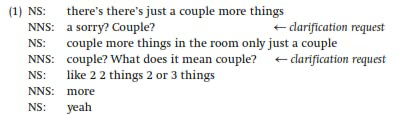
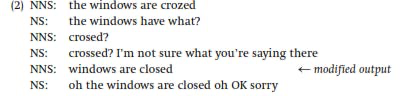
When learners attempt to communicate with other speakers in the L2, they experience difficulties and engage in further interaction with their interlocutors to resolve their problems. Interactions provide opportunities for the negotiation of meaning: through requests for clarification, repetitions, confirmations, reformulations and comprehension checks. As a result, it is more likely that the input will be tuned to the current level of competence of the individual learner (Mackey, 2006)
Example

3. Comprehensible output: Swain
• Language acquisition occurs not only when learners are exposed to comprehensible input but also when they are pushed to produce language precisely and appropriately (comprehensible output).
• Learners learn to speak by speaking.
• They need to be pushed to use alternative means of expression when communication breaks down.
• Using the foreign language offers learners the chance to try out new forms and expressions.
• Being pushed in performance shifts learners’ attention from meaning to form.
The basic principle is that “forcing” learners to speak in the L2 (i.e., putting them in a situation where they have to construct an utterance which they know may be wrong) leads to acquisition.
Schumann’s Acculturation Theory (1978)
Social distance
• If they feel that the target language and culture is more/less prestigious, or dominant/subordinate over their own.
• If their living conditions allow them to be integrated in a society or they live in a type of ghetto.
• If they are living or intend to live in the target culture for a long time.
• If there is social congruence between the source and target language and culture.
Psychological distance
• If they feel that they have or haven’t control over the new environment and a say in their process of integration.
• If their initial experience was to undergo a ‘culture shock’.
• If they feel that no matter what type of attempts they make they are unable to understand or convey their meanings in the target language.
• If they feel that the meanings that they convey are undervalued.