
1. Introduction:
“ An agent is a system that decides for itself what it must do to achieve its objectives (determined at its design). ”
2. Agent: definition & Characteristics:
An agent is a physical or virtual entity that has all or part of the following functionalities:
• Is able to act in an environment,
• Can communicate directly with other agents
• Is motivated by a set of trends,
• Has its own resources,
• Is able to perceive his environment,
• Has a partial representation of its environment
• Has skills and offers services,
• His behavior tends to satisfy his objectives according to his perception, his representations and the communications he receives.
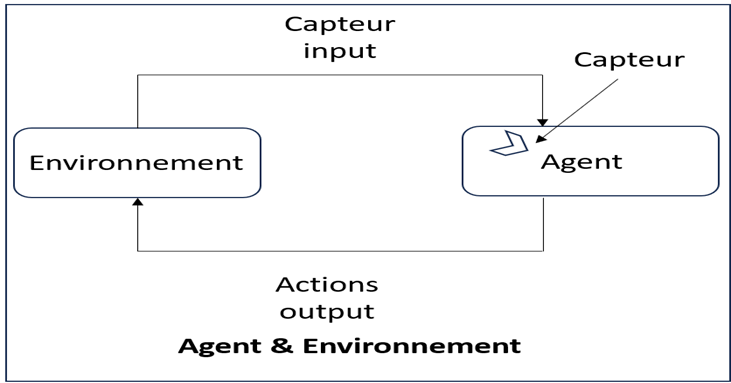
2.1 Properties of an agent:
- Autonomy : Behaviour is dependent on perceptions and representations of the environment. It acts without external control.
- Proactive: Takes initiatives to achieve its objectives, without waiting for another entity to intervene.
- Flexible: It adapts its behaviour to the environment and can collaborate with other agents to better achieve its objectives.
- Social: Interacts with other agents to achieve their goals or assist them in their activities.
- Located: It perceives and acts in its environment taking into account the space-time constraints.
Example :
A simple system, such as a thermostat, can be considered an intelligent agent.
Why is the thermostat a smart agent?
• Perception: It measures the ambient temperature using a sensor.
• Decision: Based on the measured temperature, it compares this value to a user-defined target temperature.
• Action: If the temperature is too low, it turns on the heating; if it is too high, it turns off.
Examples of agents:
- Printer (Mechanical Agent):
-
Biological Agents (Plants, Animals, Humans):
- Software Agents (Programs)
2.2 Agent Types:
- Autonomous Agents :An autonomous agent is a system capable of making decisions independently based on its environment and its objectives (e.g. Smart cars).
- Reactive Agents
A reactive agent is a type of agent that reacts directly to changes in its environment without complex planning or internal modeling (e.g. printer).
- Hybrid Agents
A hybrid agent combines the characteristics of reactive agents and autonomous (deliberative) agents (e.g. robot cleaner).
2.3 Properties of an environment:
- Accessible vs. Inaccessible:
- An accessible environment: provides complete and up-to-date information on its status. (e.g.Chess game)
- An environment inaccessible: does not allow to obtain all the information (e.g.Autonomous driving in the city).
- Deterministic vs. Non-Deterministic:
- Deterministic : Each action produces a certain effect, without uncertainty. (e.g. Sudoku games)
- Non-deterministic : An action may fail or produce unpredictable results. (e.g. Robot that delivers outside)
- Discreet vs Continuous:
- Discrete : Finite number of possible actions (e.g., chess)
- Continuous states change smoothly (e.g. taxi speed and position).
- Single vs Multi-Agent:
- Simple : Only one agent acts (e.g. solve a puzzle alone).
- Multi-Agent Multiple agents interact (e.g. play chess).
- Static vs. Dynamic:
- Static : The environment does not change without agent intervention (e.g., puzzle).
- Dynamic : The environment can change independently of the agent (e.g., taxi driving).