
Chapter 04 : Physical chemistry of transport
phenomena(Fick Law)
IV.1.Simple diffusion
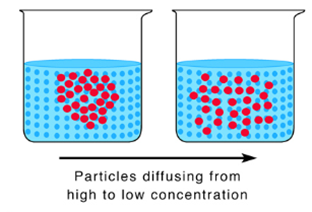
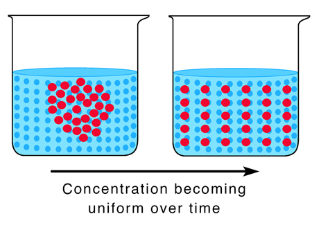
Simple diffusion is a spontaneous movement of the particles following the direction of the concentration gradient, without binding to membrane proteins and without consumption of energy in the form of ATP . Fat-soluble substances (e.g., hormones, ethanol, glycerol, and urea), neutral molecules of H2O, O2 and CO2 penetrate the cell membrane through the simple diffusion. Diffusion stops when equal concentrations are reached. Diffusion is not associated with any changes in the volumes.
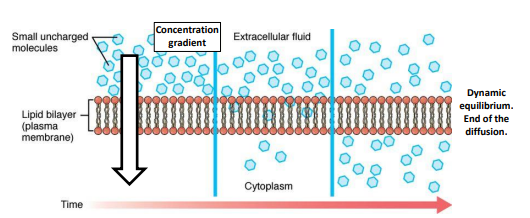
Figure 47 : Simple diffusion schematics.
IV.1.1. Permeable membrane: allows all molecules to pass through (both solvent and solute).
IV.1.2. Selective membrane: its permeability is not the same for the solvent and for the solute molecules present in the solution; that is, it allows only certain components of the mixture to pass through. Selectivity may occur based on particle size, chemical attraction or repulsion, or through active transport mechanisms.
IV.1.3.Dialyzing membrane: allows the solvent (water) and small molecules (molecular weight < 1000) to pass through.
IV.1.4.Semipermeable (hemipermeable) membrane: a particular case of a selective membrane. It allows only the solvent (water) to pass through.
IV.1.5. Partially permeable membrane: allows water and a fraction of the solutes to pass through.
IV.1.6. Perfect semipermeable membrane: allows only the solvent (most often water) to pass through; therefore, it is hemipermeable.
IV.1.7.Biological semipermeable membrane: allows the solvent, urea, and glucose to pass through; therefore, it is dialyzing.
Diffusion can be quantitatively described by Fick’s laws.
IV.2.First Law of Fick
First Law of Fick It describes the diffusion flux (J) across a surface as a function of the concentration gradient. It represents the transport of uncharged macromolecules from the more concentrated compartment to the less concentrated one.
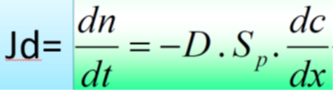
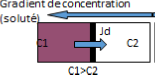
· Jd: amount of solute mass transported during the time interval Δt, expressed in mol·s⁻¹
· D: diffusion coefficient, expressed in cm²·s⁻¹ or m²·s⁻¹
· S: diffusion surface area, expressed in cm² or m²
· dc: mass concentration, expressed in g·cm⁻³ or kg·m⁻³
· dx: distance traveled, expressed in cm or m
· dc/dx: concentration gradient across the membrane
IV.3.Fick’s Second Law (Non-Steady State Diffusion)
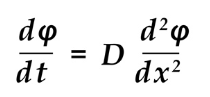
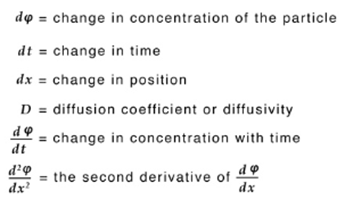
Describes how the concentration changes with time when diffusion is not at steady state for example, when gradients evolve as diffusion proceeds.
IV.3.1.Diffusion Coefficient (D)
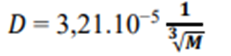
The diffusion coefficient is given by Einstein’s relation. For a spherical diffusing particle with a diameter much larger than that of solvent molecules:
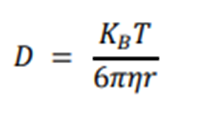
Where:
· D : diffusion coefficient
· k : Boltzmann constant
· T : absolute temperature
· η : viscosity of the medium
· r : radius of the particle
For macromolecules at ordinary temperature:
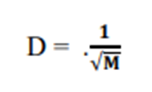
If the diffusing particle has a diameter of the same order of magnitude as that of the solvent:
Fick’s law applies only under very specific conditions:
· Low concentration of the diffusing substances
· Short diffusion distance
· Neutral solutions (uncharged species)
IV.3.2.Diffusive permeability P
In biology, the diffusive permeability P of a membrane with respect to a solute is very commonly used. It is defined as:
P=L/ D
Where:
· L = membrane thickness
· P = diffusive permeability (m·s⁻¹ or cm·min⁻¹)
· D = diffusion coefficient
In the absence of solute accumulation within the membrane, the concentration gradient dc/dxdc/dxdc/dx is uniform and equal to:
Fick’s equation can then be written as:
Δc/L
Fick’s equation can then be written as:
J=P S Δc
The negative sign has been deliberately omitted because Δc\Delta cΔc is generally taken as an absolute value. It is sufficient to remember that diffusive transport always occurs from the region of higher solute concentration to the region of lower solute concentration.
A given solute always moves toward the compartment where its concentration is lower.
IV.4.Factors Affecting Diffusion
· Temperature: Increasing temperature raises the kinetic energy of particles, thus accelerating diffusion.
· Particle size: Smaller particles diffuse faster than larger ones.
· Viscosity of the medium: In a more viscous medium, diffusion is slower.
· Concentration gradient: A higher gradient results in faster diffusion.