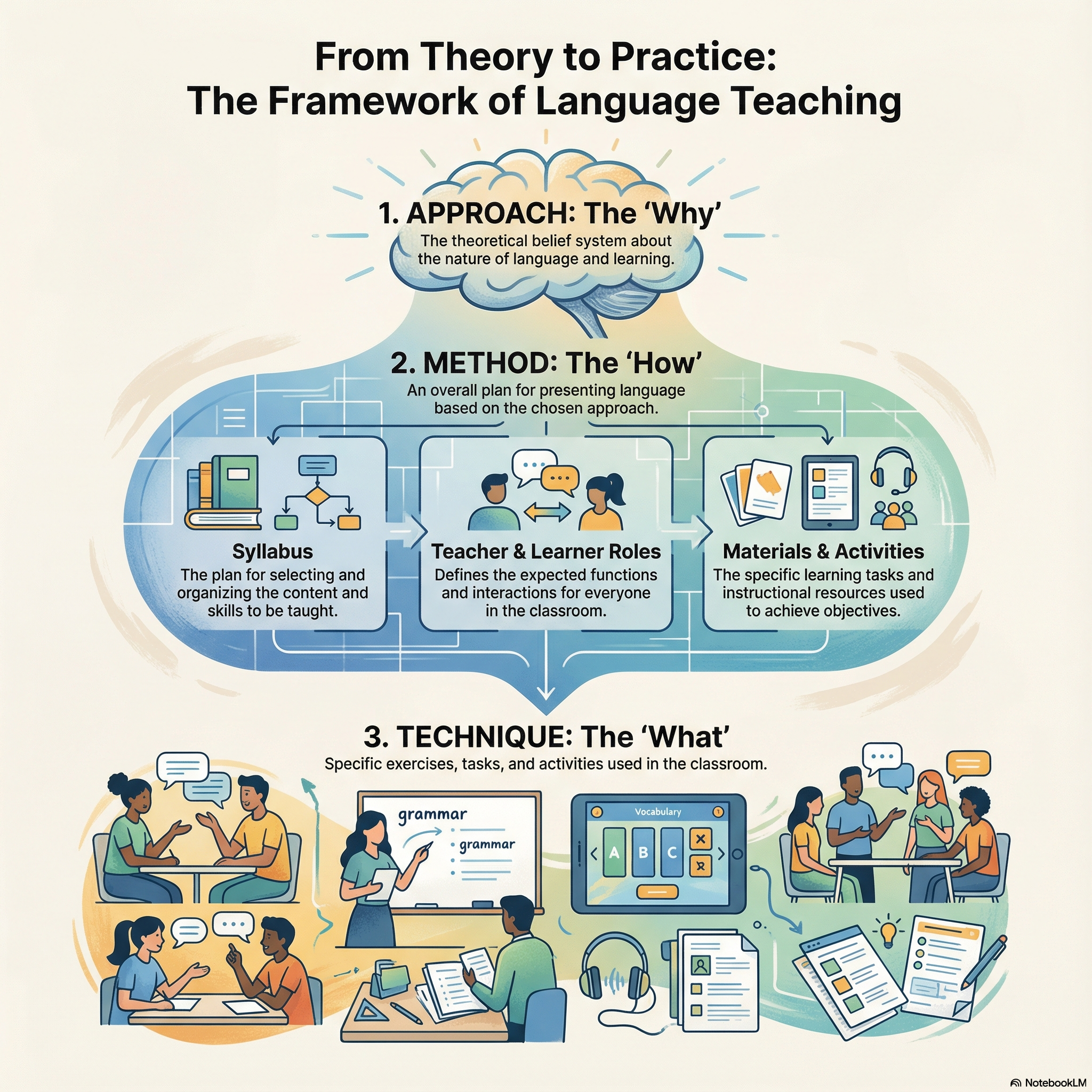
Understanding Foreign Language Teaching: Approach, Method, and Technique
The study of Foreign Language (FL) teaching methodology relies on a defined hierarchy, originally presented by Edward Anthony in 1963, which established three systematic elements: approach, method, and technique. This framework, later reformulated by Jack Richards and Theodore Rodgers (1982) as approach, design, and procedure, provides an essential structure for analyzing how languages are taught.
1. The Approach: Defining Beliefs and Theories
The approach is the foundational level, comprising a set of assumptions and beliefs about the nature of language, the nature of learning, and how both apply to pedagogical settings,. These theories are crucial because they form the source of principles and practices in language teaching.
An approach is built upon two main theoretical components:
Theory of Language
This component dictates how language is viewed and what content is prioritized for teaching.
- Structural View: If language is seen as a system of structurally related elements used for coding meaning, the grammatical dimension is prioritized. Teaching focuses on phonological units and grammatical units and operations.
- Functional View: If language is viewed as a vehicle for the expression of functional meaning, the semantic and communicative dimension of language is prioritized. Teaching centers on functions and notions of language.
Theory of Language Learning
This component addresses how learners acquire language, including the psychological and cognitive processes involved (such as habit formation, induction, inferencing, and generalization), and the conditions necessary for these learning processes to be activated.
2. The Method: The Overall Plan and Specifications
A method is the second hierarchical element and is defined as an overall plan for the systematic presentation of language based upon a selected approach. It is a pre-packaged set of specifications derived from the underlying theory of language and learning. A method encompasses various features (often called the Design):
- Objectives: The goals the method aims to achieve.
- Syllabus: This is the level where theory is put into practice. The syllabus specifies the content to be taught, the skills to be developed, and the order of the content. Critically, the theory of language adopted will directly affect the organization and selection of language content.
- Teacher and Learner Roles: Methods prescribe the functions the teacher is to fulfill in the classroom and the approach to learning the learner should take,.
- Activities and Materials: Methods prescribe the types of learning tasks and activities to be used, and the role of materials (e.g., whether they are designed to replace the teacher or are "teacher proof").
- Assessment: Specifications include how students’ language knowledge is to be assessed and the prescribed error correction policy.
3. The Technique: Classroom Action
A technique is the third and most specific element. It is the specific activity which takes place in the classroom that is consistent with the method, and therefore in harmony with the approach,. Techniques are the exercises, activities, or tasks used in the language classroom in order to realize objectives.
Ultimately, the relationships are hierarchical: Different theories (the approach) imply different ways of teaching language (the method), and different methods make use of different kinds of classroom activities (the techniques).
All in all, this lecture is summarized below